AI Studio vs Traditional Studio: The Comparison
AI voice or studio recording? A detailed comparison of cost, turnaround, quality and flexibility for professional phone messages.
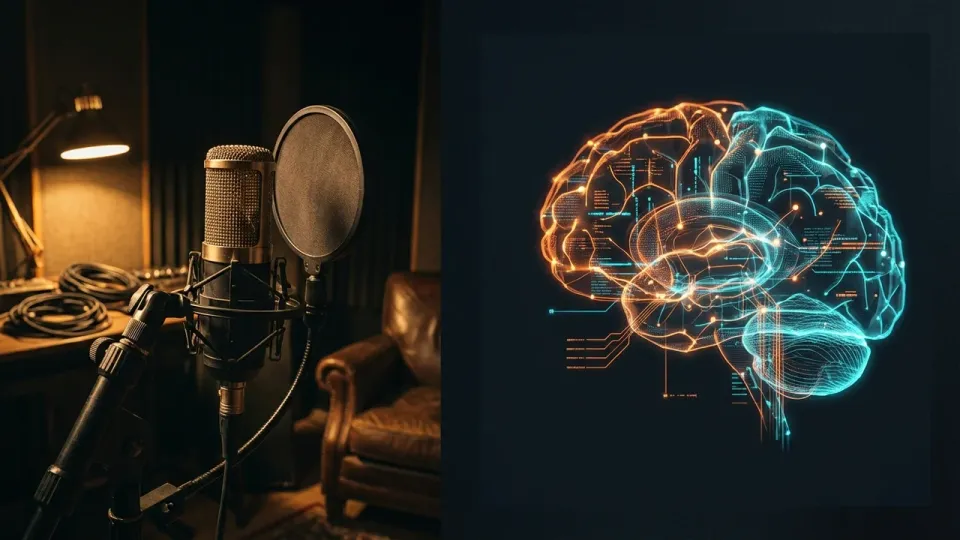
TL;DR: A phone message from a traditional studio costs between 39 and 500 EUR and takes 3 to 10 days. With AI (TTS), the same message costs 5-13 EUR and is ready in under a minute. The studio keeps its edge for brand voice identity; AI wins on price, speed and multilingual support.
You need to redo your phone messages. The text is ready, the music chosen. All that’s left is the voice. And here, two options: book a recording studio or use a text-to-speech platform. Five years ago, the question didn’t even come up. Today, with AI voices that fool the untrained ear, the choice deserves a closer look.
This comparison reviews the concrete criteria: price, turnaround, sound quality, flexibility, use cases. Not to crown a “winner,” but to help you pick the right method for your situation.
The comparison table
Before diving into the details, here’s the overview.
| Criterion | Traditional studio | AI Studio (TTS) |
|---|---|---|
| Price per message | 39 to 500 EUR depending on the studio | 5 to 13 EUR (in credits) |
| Delivery time | 3 to 10 business days | Under one minute |
| Text changes | New paid recording | Instant regeneration, included |
| Sound quality | Excellent, natural human grain | Very good, consistent and predictable |
| Language options | Surcharge per language (30 to 95 EUR) | Included, same voice in 29+ languages |
| Background music | Studio mixing, catalogue or custom | Online mixing, royalty-free catalogue |
| Output format | WAV/MP3 (sometimes with surcharge) | WAV, MP3, u-law, normalised for PBX |
| Commitment / subscription | Often annual (ATS Studios, ID2SON) | No commitment, pay-as-you-go credits |
| Availability | Business hours, studio schedule | 24/7 |
| Consistency across messages | Depends on session and voice actor | Identical with every generation |
How much does a phone message cost in studio vs AI?
AI wins on price, and the gap isn’t marginal.
Among French-speaking traditional studios, pricing varies wildly. At the lower end, Studio Low Cost charges from 39 EUR excl. VAT for a custom message in French (up to 250 characters), and 69 EUR for a 500-character text. Studio-Phonic asks 49 EUR excl. VAT for a bespoke message. myPhone Studio sits between 35 and 85 EUR depending on length.
These rates seem reasonable, but they’re from “low-cost” studios positioned on volume. Premium players like ATS Studios, ID2SON or Voxelis don’t publish their prices. They work on quotes and annual contracts. In practice, a complete message (text + voice + music + mixing) from these studios runs between 150 and 500 EUR, sometimes more when you factor in SACEM rights and additional languages.
On the AI side, the maths are different. On a platform like VoiceLab, a message costs between 5 and 13 EUR in credits depending on the plan chosen (Starter at 12.99 EUR/month for 80 credits, Premium at 24.90 EUR for 200 credits). This price includes the voice, online mixing and export in all PBX formats.
Revisions also change the equation. A studio charges for every round trip. Changing one word in an already-recorded message means calling back the voice actor, rebooking the studio, remixing. With AI, you edit the text and regenerate. It’s included in the initial credit.
For an SME that needs four or five messages (greeting, on-hold, voicemail, IVR), the traditional studio bill easily exceeds 500 EUR. With AI, the same set comes in at 25-65 EUR depending on the plan.
What are the production timelines for studio vs AI?
No suspense here: AI wins, by a wide margin.
A studio recording follows a linear process: briefing, script writing (or approving yours), casting the voice, scheduling the session, recording, mixing, delivery. With most providers, expect 3 to 5 business days in the best case. ATS Studios announces 3 days, Vocaliz Studio offers 24 hours as a rush option (with a surcharge). Add in back-and-forth on the text, a voice change, a correction, and you easily land on 7 to 10 days.
With AI, you type the text, pick the voice, click, and the message is out in under a minute. If the result doesn’t suit you, you modify and relaunch immediately. No email, no waiting.
This speed makes all the difference in certain situations. A medical practice that needs to update its voicemail to announce an unexpected closure tomorrow morning. A shop changing its hours. A company that just rebranded and needs to update all its messages within the day. Waiting 3 days simply isn’t an option in these cases.
Is the sound quality comparable?
Both reach a professional level, but the result differs.
A good recording studio delivers impeccable sound. The voice actor controls rhythm, pauses and inflections. They bring precise intent to every sentence: welcoming, reassuring, energetic. The microphone, the room’s acoustic treatment, the mixing by a sound engineer — all of this produces a rich, organic sonic texture. You hear a human being, with the subtle natural variations that make a message come alive.
Latest-generation voice synthesis (ElevenLabs-type, the technology behind most current TTS platforms) has made an enormous leap. The voices are fluid, well-paced, with natural prosody. Over a phone line compressed to 8 kHz in G.711, the difference from a human voice becomes very hard to detect for the average caller.
Nuances remain, though. AI voices are remarkably consistent. Sometimes too consistent. A human voice actor will naturally vary their pace, place a breath, lean slightly into a word. This irregularity isn’t a flaw — it’s what gives character. Conversely, AI consistency becomes an asset when you need coherence across 15 different messages for a franchise network.
In short: the human studio has the advantage of grain and intent. AI has the advantage of consistency and predictability. Over a phone line (as opposed to audiophile headphones), both pass the “sounds professional” test.
Why is AI more flexible?
AI wins on flexibility, and it’s probably the most underrated criterion.
Multilingualism first. A traditional studio has to hire a native voice actor for each language. At Studio Low Cost, adding English costs 30 to 50 EUR more per message. German, Dutch, Spanish: 40 to 95 EUR extra per language per message. For a Belgian company needing messages in French, Dutch and English, the bill nearly triples.
With AI, the same voice speaks 29 or more languages. You keep the same timbre, the same sonic identity, and just change the text and target language. The cost stays the same: one message, one credit, regardless of language.
Mid-course changes are another factor. You approved a message, it’s been running for two months, and you realise a phone number has changed. In a studio, that’s a new recording. With AI, you change the digit and regenerate in 30 seconds.
Mixing has evolved too. Recent TTS platforms offer online mixing: adjust voice volume relative to music, add fades, set the timing. No sound engineer or specialised software needed. It doesn’t replace high-end studio mixing, but for a phone hold message, it gets the job done and then some.
For compatible audio formats for your phone system, see our PBX audio format guide.
When does the traditional studio remain the best choice?
AI doesn’t replace everything. Certain situations clearly give the advantage to human studio recording.
Brand voice identity. Your company wants a recognisable voice, a specific timbre that’s part of your sonic identity just like your logo? A dedicated voice actor remains the benchmark. Major brands (SNCF, telecom operators, banks) work with exclusive voices. This isn’t (yet) reproducible with AI.
Advertising spots and marketing content. A radio spot, a voiceover for a corporate video, a branded podcast: these formats demand fine artistic direction, multiple takes and acting skills. AI can’t (yet) take direction like “be warmer at the end, as if you’re talking to a friend.”
Premium branding. A 5-star hotel, a corporate law firm, a luxury brand: in these contexts, every touchpoint matters and the “handmade” quality has perceptible value. The client calling a palace hotel expects a certain refinement that voice synthesis, however excellent, doesn’t quite convey yet.
Long, narrative content. A 3-minute message with tonal variations, emotion and dramatic pauses: the human voice actor still comes out on top for these extended formats.
When is AI the better option?
Conversely, certain use cases are a perfect fit for voice synthesis.
SMEs with a limited budget. A 5-person business that needs 3-4 decent phone messages doesn’t have 400 EUR to spend on a studio. At 25-65 EUR for the full set, AI makes professional messaging accessible.
Multi-site businesses. A chain of clinics with 12 different addresses, each needing its own hours and contact details in the messages. In a studio, that’s 12 recording sessions. With AI, it’s one template modified 12 times in an hour.
Frequent updates. Seasonal hour changes, exceptional closures, temporary promotions: when content shifts often, the ability to regenerate instantly justifies the switch to AI on its own.
Multilingualism. Any business operating in multiple languages (and in Belgium, that’s nearly everyone) saves hundreds of euros by going through AI rather than multiplying studio sessions per language.
Urgency. Your greeting needs to change today, not in 5 days. AI is the only realistic option.
For a full overview of available voices, our article on the best AI voices for telephony details the selection criteria.
Do you have to choose between studio and AI?
The honest answer is that both have their place.
A medical practice managing its on-hold, voicemail and IVR messages doesn’t need a studio. AI does the job for a fraction of the price, with the ability to modify messages yourself whenever hours change.
A bank overhauling its entire sonic identity (greeting, on-hold, 3-level IVR, 4 languages, consistency with TV advertising) needs an artistic director, a dedicated voice actor and a mixing studio. AI isn’t up to that brief.
And between the two extremes, there’s every hybrid case. You can absolutely use a studio for the main greeting (the one everyone hears first) and hand the rest — on-hold, voicemail, after-hours, IVR — to AI. That’s exactly what more and more businesses are doing.
For a complete understanding of the different message types and their roles, see our complete guide to professional phone messages.
Frequently asked questions
Is AI voice quality really comparable to a studio?
Over a G.711 phone line (8 kHz, standard codec), most callers won’t tell the difference. ElevenLabs voices, used by current TTS platforms, have reached a level of naturalness that passes the ear test. On a high-fidelity medium, however (podcast, video, radio ad), a human voice actor remains superior on nuances of intent and emotion.
Can I customise an AI voice to make it “my company’s voice”?
Partly. You can choose a timbre, gender, language and style from dozens of available voices. Some platforms also allow cloning an existing voice (with the speaker’s consent). However, fine artistic direction (“sound more upbeat on this sentence”) isn’t yet at the level of a voice actor taking live instructions.
I change my messages often. How does AI handle that?
This is precisely the ideal use case. You edit the text, regenerate, download. The whole thing in under two minutes. No quote, no scheduling, no extra billing if you’re on a credit plan. For businesses that update their messages every month (seasonal hours, promotions, closures), AI removes all the friction.
How much does a complete phone message package cost in studio vs AI?
For a standard package (greeting + on-hold + voicemail + IVR, in one language), expect between 200 and 800 EUR in a traditional studio depending on the provider. The same package in AI costs 20-50 EUR depending on the platform and plan. Add a second language and the gap widens: the studio charges a per-language surcharge (30 to 95 EUR per message), while AI generates in any language at the same rate.
Pricing sources: Studio Low Cost (studio-lowcost.com/tarifs), Studio-Phonic (studio-phonic.com/tarifs), myPhone Studio (myphonestudio.com/page/tarifs). Premium studio rates (ATS Studios, ID2SON, Voxelis) based on market-reported ranges, as these players work on quotes. AI pricing based on VoiceLab rates (voicelab.cloud).